EN
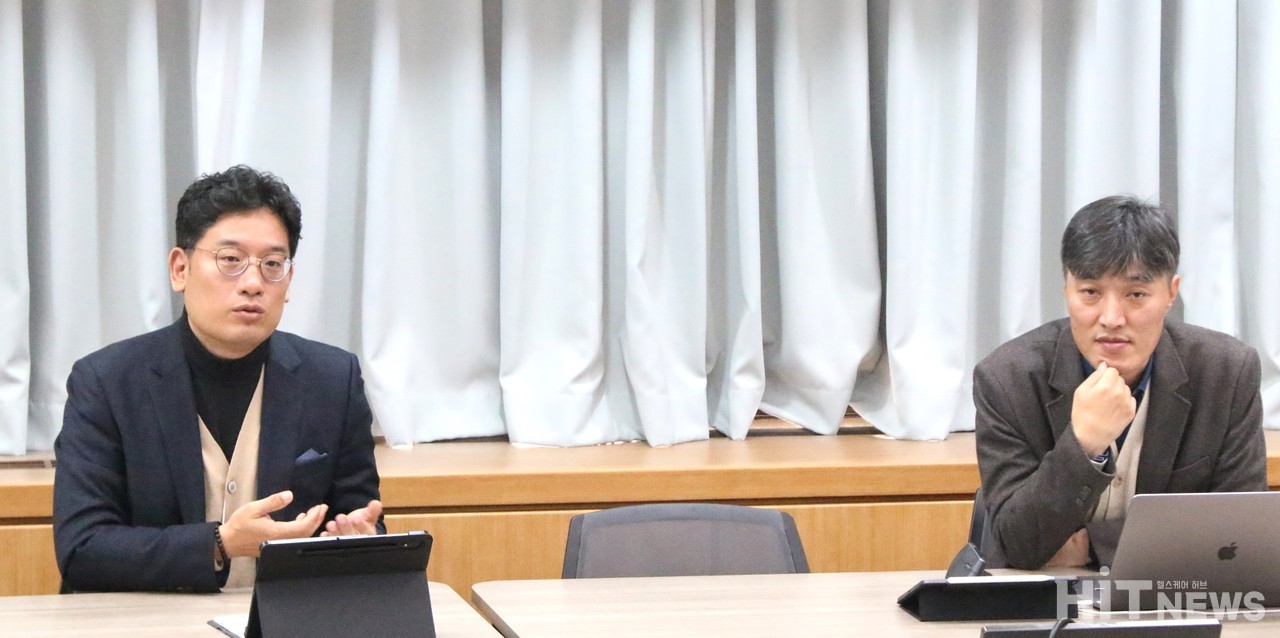
Seungha Lee, Center Director of Daewoong Pharmaceutical Osong Plant, and Jeongjae Lee, Director of idsTrust.
“Smart factory allows for more three-dimensional molding management”
“Work collaboration, productivity improvement, and cost savings are possible through the idsTrust solution.”
By connecting the GMP-specialized information technology (IT) solution of its subsidiary 'idsTrust' to the Osong plant where Daewoong Pharmaceutical exists, 'Data Integrity∙DI' and 'Cost Manufacturing Competition' were brought together.
Daewoong Pharmaceutical's Osong factory is currently a manufacturing facility that has received level 4 smart factory certification (up to level 5) from the 'Smart Manufacturing Innovation Promotion Team' affiliated with the Small and Medium Technology Information Promotion Agency under the Ministry of SMEs and Startups. This is a place with the best IT that can provide solutions through fair operations.
To inquire about the meaning of Daewoong Pharmaceutical's Osong Factory's Smart Factory Certification and GMP Solution Patch, Heat News interviewed Lee Seung-ha, Center Director of Daewoong Pharmaceutical's Osong Factory, and Lee Jeong-jae, Head of ID&Trust, in collaboration with the Korea Pharmaceutical and Bio Association's professional press response team on the 15th.
3 elements of smart factory, ‘automation, unmanned, and digitalization’
For what reason did Daewoong Pharmaceutical introduce a smart factory at its Osong factory? Center Director Seungha Lee said, “We have introduced a smart factory to take the lead in the 4th Industrial Revolution and a situation where pharmaceutical quality regulations are continuously being strengthened around the world,” and added, “Through this, we aim to secure global level manufacturing and quality competitiveness.” “He explained.
To this end, Daewoong Pharmaceutical invested a total project cost of 210 billion won and completed the construction of a smart factory that meets the U.S. Food and Drug Administration (FDA) cGMP level in 2017. Seungha Lee, Center Director of Osong Factory, selected automation, unmanned operation, and digitalization as essential elements of a smart factory.
Director Lee said, “Our factory has secured the quality of unit processes through various IT solutions that in principle prevent artificial errors in each manufacturing process, and has implemented data management capabilities that exceed global requirements.” “We have secured a high level of quality competitiveness and cost manufacturing competitiveness through a preventable production system, a digital data management system that cannot be forged or altered, and a real-time environmental and process monitoring system,” he explained. He added, “At the same time, we wanted to become a factory that would create a super gap in competitiveness by nurturing highly trained experts.”
Director Lee believes that the recent trend of building smart factories in the pharmaceutical industry is because, unlike other industries, it has a direct impact on human life and health. This is because all processes, from raw materials to manufacturing, packaging, and delivery, must be managed thoroughly and hygienically. Ultimately, all of these problems come down to quality control, and center director Lee explains that establishing a system to guarantee this is emerging as a major issue.
Director Lee said, “Recently, pharmaceutical quality regulations and standards have been continuously strengthened around the world, and fundamental solutions are being called for to prevent artificial errors and artificial manipulation of data.” He added, “Following this trend, automated quality inspection is required.” “There is a movement to establish a production system to prevent human errors at the source and to introduce a system in which all data is recorded in real time and cannot be modified or organized,” he added.
In other words, smart factories enable pharmaceutical quality control at a higher level. This can lead to preventing contamination during the pharmaceutical manufacturing process, improving process integrity, and improving drug productivity and efficiency.
Introduction of GMP specialized solution by subsidiary idsTrust
Daewoong Pharmaceutical's Osong Factory introduced 'GxP Solution', a GMP-specialized IT solution from its subsidiary IDS&Trust. According to Lee Jeong-jae, head of IDS&Trust, simply put, a GxP solution is a solution that helps companies comply with industry regulations. By automating, recording, and managing the processes within the GMP system, the quality of the manufacturing site can be improved in an environment where arbitrary manufacturing is impossible.
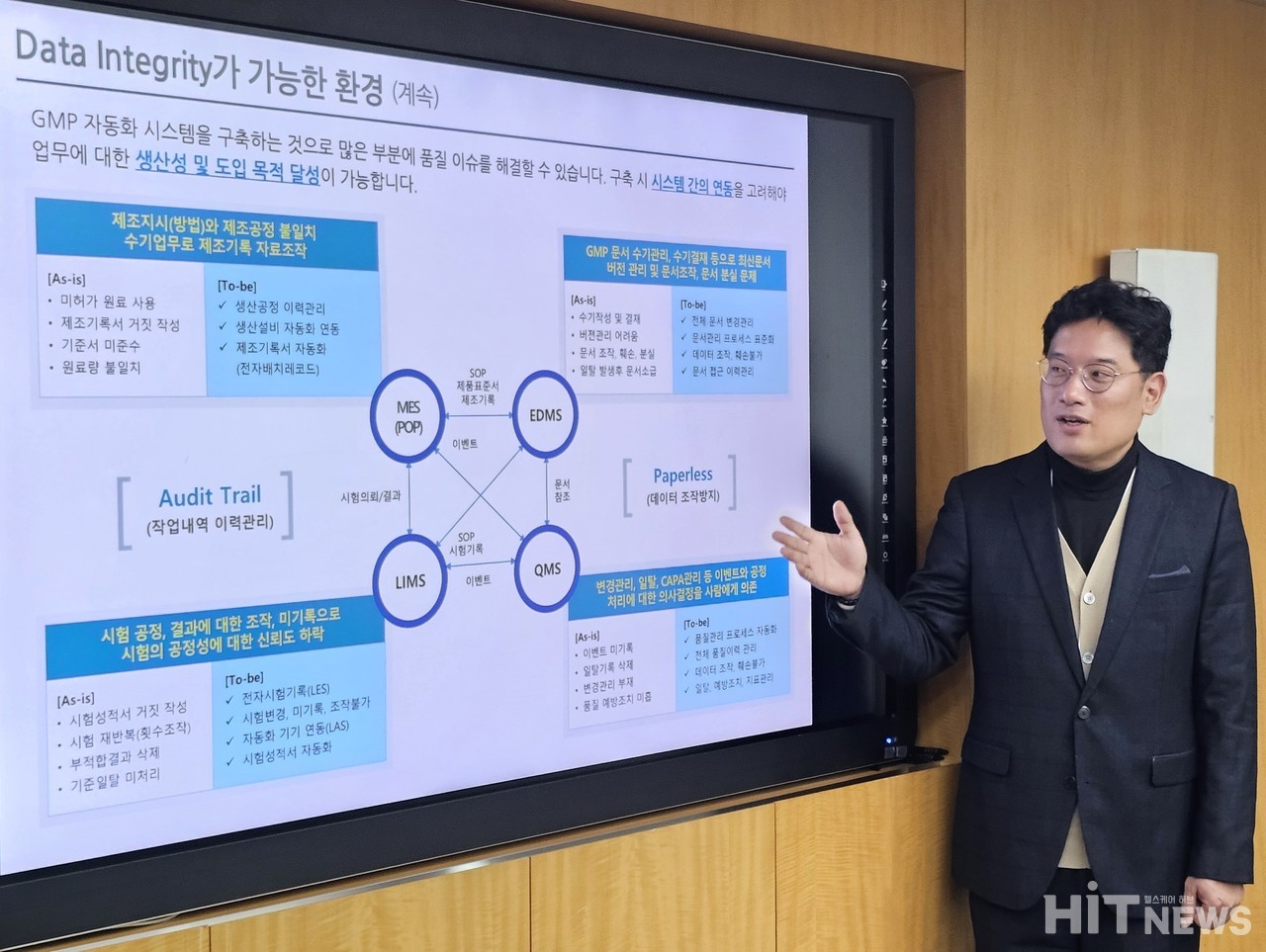
This solution links the company's internal systems such as △MES (Production Management System) △LIMS (Laboratory Information Management System) △EDMS (Document Management System) △QMS (Quality Management System). Through this, Director Lee Jeong-jae said, △Compliance with global GMP regulations. It was explained that the following effects can be expected: realization, automation of work, establishment of a constant surveillance system, improvement of work productivity, and realization of cost reduction through reduction of quality and management costs.
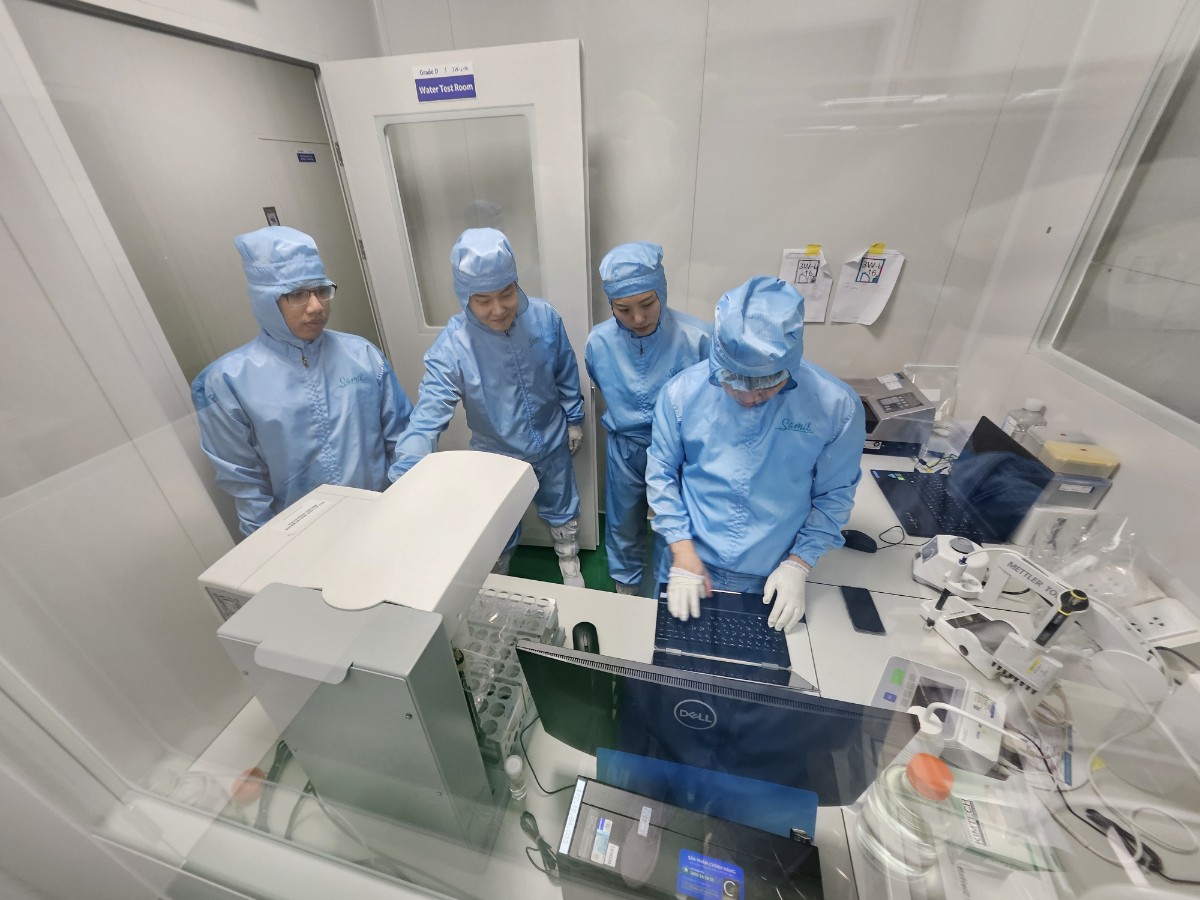
Center Director Seungha Lee said, “The Osong factory has all the IT systems necessary for operation, so it is possible to monitor and control the process progress in real time from the receipt of raw materials to the shipment of finished products.” He added, “With the current paperless factory concept, manufacturing test records and “It is operated as a customized solution, with all logs automatically recorded and managed,” he explained. He added, “Currently, various tasks are underway to create new value by utilizing various digitized data.”
Building a smart factory provides not only quality but also productivity and cost ratio advantages.
Daewoong Pharmaceutical monitors all stages of the manufacturing process in real time through various IT systems in quality control at the Osong plant. DI and cGMP, which have been maintained in this way, serve as key factors in successfully completing domestic and international inspections.
A representative example is the inspection by Brazilian regulator ANVISA, which was conducted from September 4th to 7th. ANVISA completed the inspection of Daewoong Pharmaceutical's Osong factory with 'Zero Observation'.
But the benefits of smart factories are not limited to quality control. Center Director Seungha Lee's opinion is that it contributes to productivity and cost competitiveness. Director Lee said, “Through the establishment of a smart factory, we confirmed that productivity indicators have improved by 40% and the cost ratio has been reduced by more than 30%,” adding, “Compared to other manufacturing plants of the same size, we have achieved a high level of 150-200%. “It can be said to be productive,” he explained.
Meanwhile, due to the nature of the Osong Factory, which is operated as a four-stage smart factory, the capabilities of some employees who operate the system are also an important factor to consider. To this end, Daewoong Pharmaceutical's Osong factory operates a quality circle and periodically learns essential elements for smart factory operation, such as big data, machine learning, and artificial intelligence (AI).
Director Lee said, "In fact, the 'Ursa Major Quality Circle' at our factory that received this in-house big data training program (DABA) △ introduced a laser printing function using machine learning to analyze work time for each process △ applied an automatic sampling and measurement system for process inspection. “By making improvements such as these, we won the grand prize in the smart factory category and a commendation from the governor of North Chungcheong Province at last year’s quality circle competition,” he explained.
Source: Hit News (http://www.hitnews.co.kr)


.svg)
Destruction procedure
Destruction method
Exception
Posts and attachments, excluding personal information, can be backed up and stored by the company.
Personal information manager
If you need to report or consult about other personal information infringement, please contact the organizations below.